Lead Enrichment for LinkedIn Data in 2026: Coverage, Freshness, and the Tested Numbers
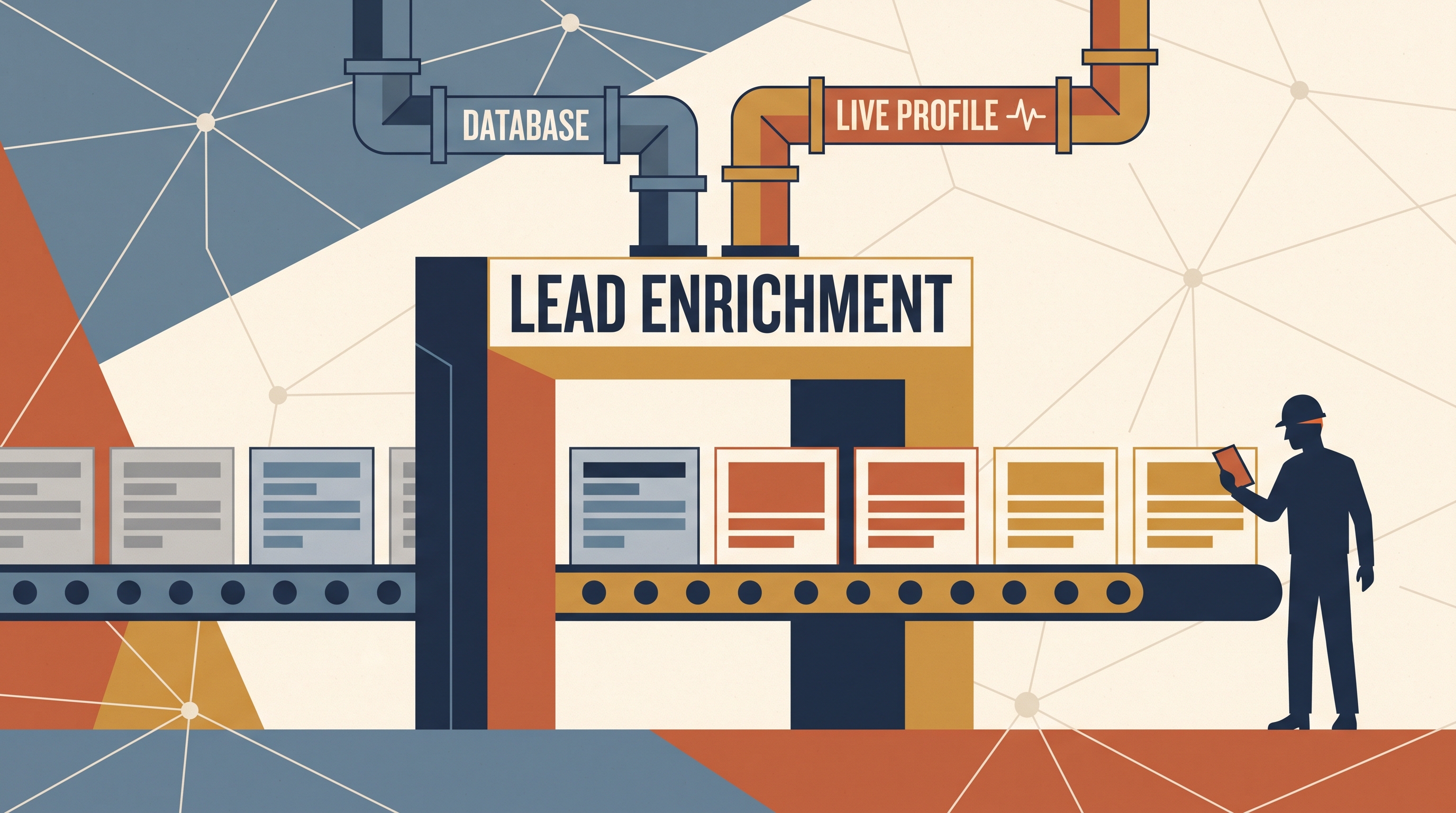
A lead comes in with a name, a company, and a LinkedIn URL, and your CRM fills the missing fields from a database that last saw that person some unknown number of months ago. That fill-in step is lead enrichment, and every guide ranking for the term is written by a company selling a piece of it, this page included: we operate LinkedIn scraping infrastructure for a living, so our bias runs toward fresh profile data over big static databases. Keep that seat in view while you read.
Key takeaways
- Lead enrichment means filling and refreshing the fields on a lead record from outside data sources, and the two failure modes are coverage (no record found) and freshness (a record found, but stale).
- Vendor accuracy claims and tested accuracy diverge: an independent benchmark run on 1,000 leads measured both major databases well below their marketing numbers.
- Stale data announces itself late: as Cognism’s own guide puts it, “the biggest clue that your data isn’t right is a rise in bounced emails when you run a campaign”.
- A LinkedIn profile is the one lead source that updates itself, because the lead maintains it. Live profile scraping turns that into an enrichment input, which is the corner we sell into, so weigh it accordingly.
What is lead enrichment, actually?
Adding fields you did not capture to leads you already have. Cognism’s glossary-style definition is that “lead enrichment involves gathering, organising, and examining data related to a customer’s interest in a company’s offerings”, which is accurate and bloodless. In practice it means: a form gave you an email, and enrichment adds title, company size, industry, and a LinkedIn profile so routing and scoring have something to work with.
The plumbing matters more than the definition. Enrichment tools sit between your CRM and a set of data sources, and the quality of the output is bounded by the staleness of whichever source answers. That bound is the part most guides skip, so it is the part worth examining next.
Why does enriched data go stale so fast?
Because the underlying databases are snapshots of people who keep moving. Job changes, layoffs, promotions, and rebrands all happen between crawls, and a record enriched today can describe a person as they were last year.
Cognism is blunt about the consequence: “companies cannot function effectively with legacy data. Sales data deteriorates quickly, and out-of-date information can seriously harm your sales or marketing campaigns”. The same guide notes that as data decays, routing and segmentation break down quietly.
Sellers feel this before ops teams measure it. The complaint that shows up in every community thread about enrichment tools is some version of “the data is outdated”: the title is two roles old, the company is wrong, the email bounces. Bounces are the visible symptom; the invisible one is an SDR personalizing outreach against a job the prospect left. Which raises the fair question of how big the gap really is.
The tested numbers are lower than the marketing numbers
An independent benchmark by Cleanlist enriched the same thousand-lead sample through the two best-known databases and measured what came back. ZoomInfo returned valid emails for 84% of records in that test, and Apollo for 78% of them, with both vendors weaker on mobile numbers and both, in Cleanlist’s phrasing, quietly degrading on small-company records.
Those are respectable numbers for cached databases. They are also the ceiling, measured on the easiest field. Freshness of titles and companies, the fields that decay fastest, is what the benchmarks cannot easily score, and it is where the snapshot model is structurally weakest.
What does the 5 minute rule mean for enrichment?
The rule says a lead contacted within minutes of showing interest converts dramatically better than one contacted later, which is why speed-to-lead is a sales-ops obsession.
For enrichment, the implication is architectural: the fill-in step has to run in the seconds between form submit and rep notification, not in a nightly batch. An enrichment source that is accurate but slow loses to one that is slightly less complete but answers inside the routing window.
Speed and freshness are different problems, though, and solving one does not solve the other. A fast answer from a stale cache is still stale. That is the gap live profile data closes.
Where does live LinkedIn enrichment fit?
As the freshness layer, next to a database, not instead of one. Our earned opinion, from operating the scrapers: databases are the right tool for coverage and the wrong tool for freshness, and LinkedIn profiles are the inverse.
A cached database will find an email a live profile never exposes. A live profile scrape will return the title, company, and recent activity as the lead themselves published it this week, which no snapshot can promise. We watch this daily across the profile enrichments running through our Apify actors: the workflows that convert are the ones that route coverage questions to a database and freshness questions to a live call.
Stated as trade-offs, since every vendor page owes you those:
- Skip Atomus if you need emails or phone numbers (we return neither), or if a single all-in-one enrichment subscription is operationally simpler for your team. It often is.
- Use a live scraper step if the fields that matter to you are title, company, and activity, you want per-result pricing ($6 per thousand profiles found) instead of seat licenses, and you want no LinkedIn account in the loop.
- Use both inside an orchestrator: that pattern is what Clay-style waterfall enrichment does at the data layer of a GTM stack, cache first for coverage, live call for freshness.
The honest summary: enrichment quality is not one number, it is coverage times freshness, and the vendors quoting you a single accuracy figure are choosing the flattering factor. Buy coverage from a database, buy freshness from the source the lead updates themselves, and measure both by bounce rate and title accuracy on your own pipeline, not by anyone’s marketing page, ours included.
Frequently asked questions
- What is the meaning of lead enrichment?
- Lead enrichment is filling in and refreshing the fields on a lead record, such as title, company, industry, and LinkedIn profile, using outside data sources. It runs between your form capture and your CRM so routing and scoring work with complete records.
- What is an enrichment lead?
- An enrichment lead is simply a lead record that has been run through an enrichment step: the contact you captured plus the appended fields a data source filled in. The quality of those appended fields depends on the coverage and freshness of the source that answered.
- What is the 5 minute rule for leads?
- It is the sales-ops guideline that a lead contacted within five minutes of showing interest converts far better than one contacted later. For enrichment it means the fill-in step must run in real time between form submit and rep notification, not in a nightly batch.
- How much should you pay for lead generation?
- There is no single right number; anchor on cost per qualified conversation, not cost per record. Cached databases price per seat or credit, live scrapers price per result, and the right mix depends on whether your bottleneck is coverage or freshness.