Clay and LinkedIn in 2026: What the Enrichment Actually Does, and Where a Scraper API Fits
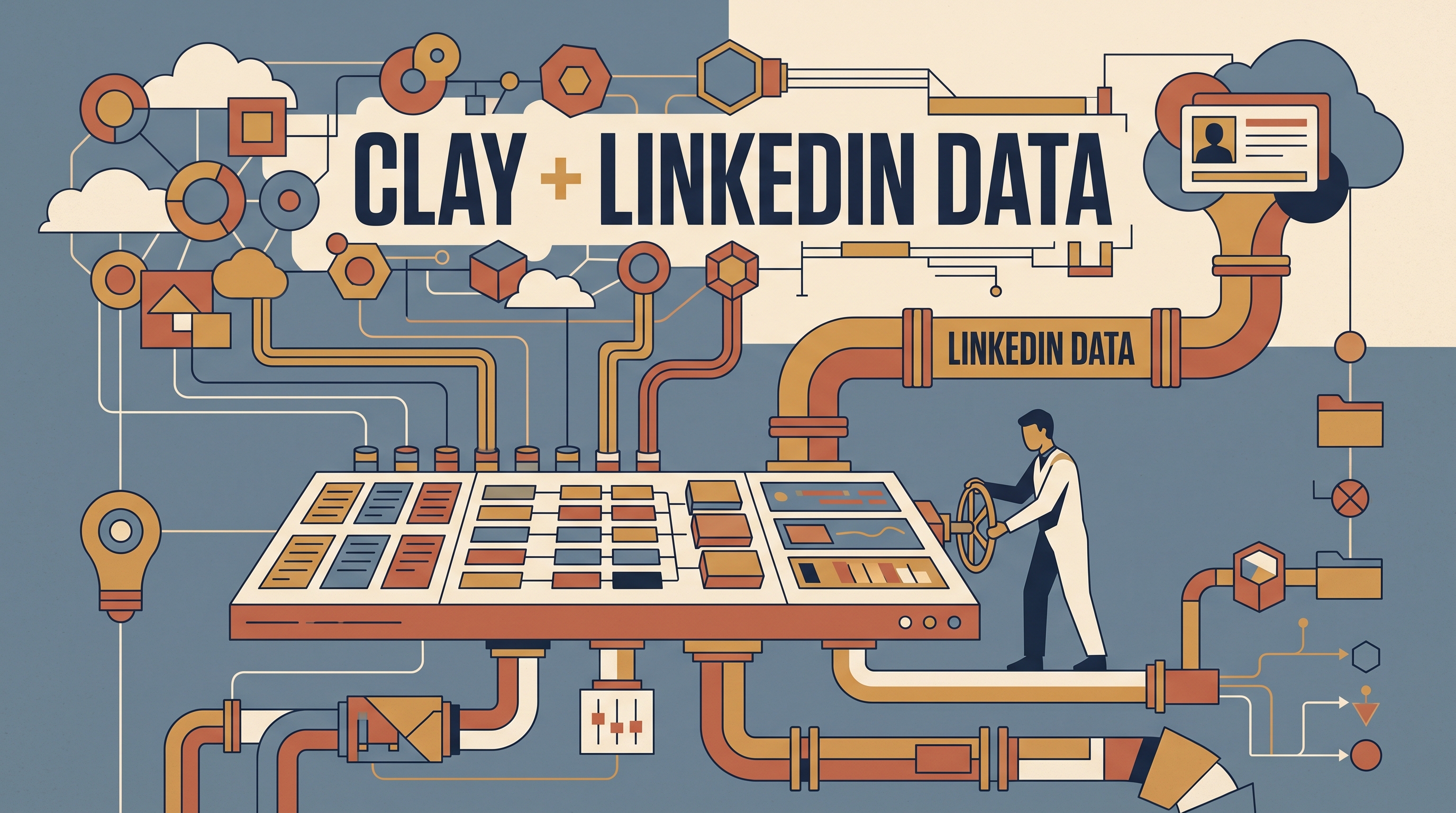
You paste a column of LinkedIn profile URLs into a Clay table, add an enrichment column, and Clay tries provider after provider on each row until one returns a match, spending credits as it goes. That loop is what “Clay LinkedIn enrichment” means in practice, and every page explaining it is written by a vendor with a stake, this one included: we build LinkedIn scraper APIs ourselves, so we sit inside the exact stack this post describes. Read everything below knowing that seat, because the honest answer to “does Clay integrate with LinkedIn” is more interesting than either Clay’s marketing or ours.
Key takeaways
- Clay has no direct pipe into LinkedIn profiles: its native LinkedIn integration is ad-audience syncing, and profile data reaches your table through third-party providers in its marketplace.
- The demand behind this query is literal skepticism: the top community result is an r/sales thread titled “Can you TLDR what CLAY does, why is it all the rage on LinkedIn?”
- Clay’s paid plans start at $167 a month, with usage billed on top in credits, which is where most of the community’s cost complaints live.
- If you already hold profile URLs and need fresh activity (posts, reactions, comments), a per-event scraper call can skip the waterfall entirely. That is the corner we sell into, so weigh it accordingly.
Does Clay integrate with LinkedIn?
Not the way the question implies. LinkedIn offers no open API for profile data, so Clay cannot plug into it directly, and neither can anyone else. Clay’s one native LinkedIn integration is advertising: it can “sync targeted ad audiences to LinkedIn, Meta, and Google”. Profile-level data arrives through third-party data providers in Clay’s marketplace, not from LinkedIn itself.
That distinction is invisible in a demo and it matters in production. When an agency guide ranking for this query notes that “Clay can scrape LinkedIn profiles to gather more detailed information about contacts”, what actually happens is that Clay routes your row to providers who maintain scraped LinkedIn datasets or run live scrapes, then normalizes whatever comes back. The same article lists LinkedIn URL matching and data hygiene as the LinkedIn-adjacent jobs Clay does well, and both are orchestration jobs, not scraping jobs.
We run that kind of scraping infrastructure ourselves, so we can say plainly: the supply chain behind a Clay LinkedIn column is scrapers all the way down, wrapped in a marketplace. That hidden supply chain is also part of why the tool confuses people, which is exactly what the loudest community thread asks about.
Why is Clay all the rage on LinkedIn?
Two reasons: Clay runs one of the most aggressive content engines on LinkedIn, and the product underneath earns a real share of the noise. The confusion is genuine enough that an r/sales user asked, verbatim, “Can you TLDR what CLAY does, why is it all the rage on LinkedIn?” and a LinkedIn creator got engagement with the blunter “What the hell is Clay and how does it work?”
The thread’s replies split cleanly. One camp: “Never understood the hype. Ridiculously expensive too.” and “I have seen it on demos and I was so confused what the hype was about lol”. The other camp explains the actual product better than most vendor pages. Clay, per one commenter, lets you run raw data “through a sequence of steps” that clean it, enrich it against “a ton of data providers”, scrape websites, and push results back to your CRM, and “to get the same results without clay isn’t impossible but it is implausible.”
Both camps are right, which is the honest TLDR. The hype is manufactured on LinkedIn by Clay and its agency ecosystem; the capability underneath is real. So it is worth being precise about what that capability actually is.
What Clay is genuinely great at: orchestration and waterfall enrichment
Clay’s real product is the table, not the data. It sequences providers, formulas, AI steps, and CRM pushes into one workflow, and its waterfall enrichment feature, in Clay’s own words, lets you “combine multiple data providers for the best coverage”: if provider one misses, provider two tries, and you pay only on a hit.
The marketplace is the moat. Clay lets you buy data from 200+ providers in one place, which turns a procurement problem (contracting each data vendor separately) into a checkbox. That is why a customer quote on Clay’s own homepage calls it “the orchestration layer for everything GTM”, and why we, a data vendor, still recommend it for multi-source workflows. As one r/sales commenter put it after the hype debate: “It’s not magic, it’s a really good tool.”
It is also not free of sharp edges, and one edge cuts everyone eventually.
The complaint that keeps coming back is the credit bill
Every data step in a Clay table consumes credits, and credits start at $0.05 each on top of the platform fee. The r/sales thread flags “cost ballooning through the credit pricing” alongside calling it “one of the least intuitive tools I’ve used”. A GTM practitioner on LinkedIn went further: “has everyone quietly accepted how much of a rip-off Clay has become? No disrespect. Excellent product.”
That cost structure is not a bug, it is the marketplace margin. Which raises the question we are obviously positioned to answer, and obviously biased on.
Where does a dedicated LinkedIn scraper API fit next to Clay?
As the data step, not the table. Clay stays the spine of the workflow; an HTTP API column calls the scraper directly and writes JSON back into the row. The fit is narrow and specific: you already hold LinkedIn profile or post URLs, and you need current data (title today, posts, reactions, comments this week) rather than a database record from whenever a provider last crawled it.
Our earned opinion, from operating these actors: waterfall enrichment is the right default for coverage problems and the wrong default for freshness problems. A waterfall shines when you are hunting a scarce field like an email across many databases. When the input is a LinkedIn URL and the question is “what did this person do this week”, there is nothing to waterfall: one live call either returns the activity or it does not, and stacking cached databases in front of it only adds cost and staleness. Across roughly 2 million profile enrichments in our own Apify telemetry, the runs that feed reply-getting outbound are the ones pulling engagement signals no static provider carries.
The trade-offs, stated plainly:
- Skip Atomus if you need emails or phone numbers (we return neither), if your volumes are small, or if staying inside Clay’s native marketplace is worth the convenience premium to you. It often is.
- Use a direct scraper step if you want per-event pricing with a published rate ($6 per 1,000 profiles found) instead of platform credits, and no LinkedIn account or cookies in the loop, so there is no account to burn.
- Use both when Clay orchestrates and the scraper feeds it: that is the data layer in a GTM stack, and it is the pattern we see working.
The r/sales skeptics asked the right question. Clay is all the rage because orchestration is genuinely valuable and its marketing is genuinely loud. Buy the table for what the table does, and pick each data source in it, LinkedIn included, on its own price and freshness, not on the rage.
Frequently asked questions
- Does Clay integrate with LinkedIn?
- Not directly for profile data, since LinkedIn offers no open API for it. Clay's native LinkedIn integration is ad-audience syncing; profile-level data reaches your table through third-party data providers in Clay's marketplace, often via waterfall enrichment.
- What is Clay AI used for?
- Clay's AI features are used to research accounts and people, fill data gaps that structured providers miss, and draft personalized outreach copy inside the enrichment table. They run as steps in the same row-by-row workflow as the data providers.
- What is a clay profile?
- That question refers to a different product: a personal-CRM app also named Clay, whose profiles showcase your professional background, bio, and work history on a public page. It is unrelated to Clay.com, the GTM enrichment platform this post covers.
- Is Clay a good company?
- Community sentiment splits. Practitioners on r/sales call the product genuinely powerful but steep on both learning curve and credit costs, and even its critics concede it is an excellent product. Whether it is worth it depends on your volume and how many data sources you need orchestrated.