What Is GTM Engineering? An Honest Definition From the Data Layer
You can tell a job title is having a moment when half of r/sales asks what it means and the other half insists it does not exist. GTM engineering is the practice of building the automated systems that take a product to market: enrichment pipelines, scoring logic, and AI workflows that find buyers and reach them without an army of SDRs. Skeptics call it RevOps in a trench coat. They are partly right, which is exactly why this guide takes them seriously.
Key takeaways
- GTM engineering means building and running the systems that turn buying signals into revenue motion, in ZoomInfo’s definition: enrichment, scoring, routing, and automated outreach.
- The term is young and vendor-driven: searches for “gtm engineering” run about 2,900 a month in the US as of July 2026 (DataForSEO), and the top result is Clay, the vendor that popularized the role.
- The skeptics have a case. Part of the job is classic RevOps under a newer name; the genuinely new part is that the pipeline is now built in code and prompts, not clicked together in admin panels.
- If your outbound is one pipeline and one segment, you probably need the plumbing before you need the hire.
What is GTM engineering?
The short version: it is the discipline of building, automating, and scaling the systems that take a product to market. That covers data collection and enrichment, lead scoring and routing, and outreach that runs without manual steps. ZoomInfo’s phrasing is the cleanest on record: the systems that “turn buying signals into revenue motion”.
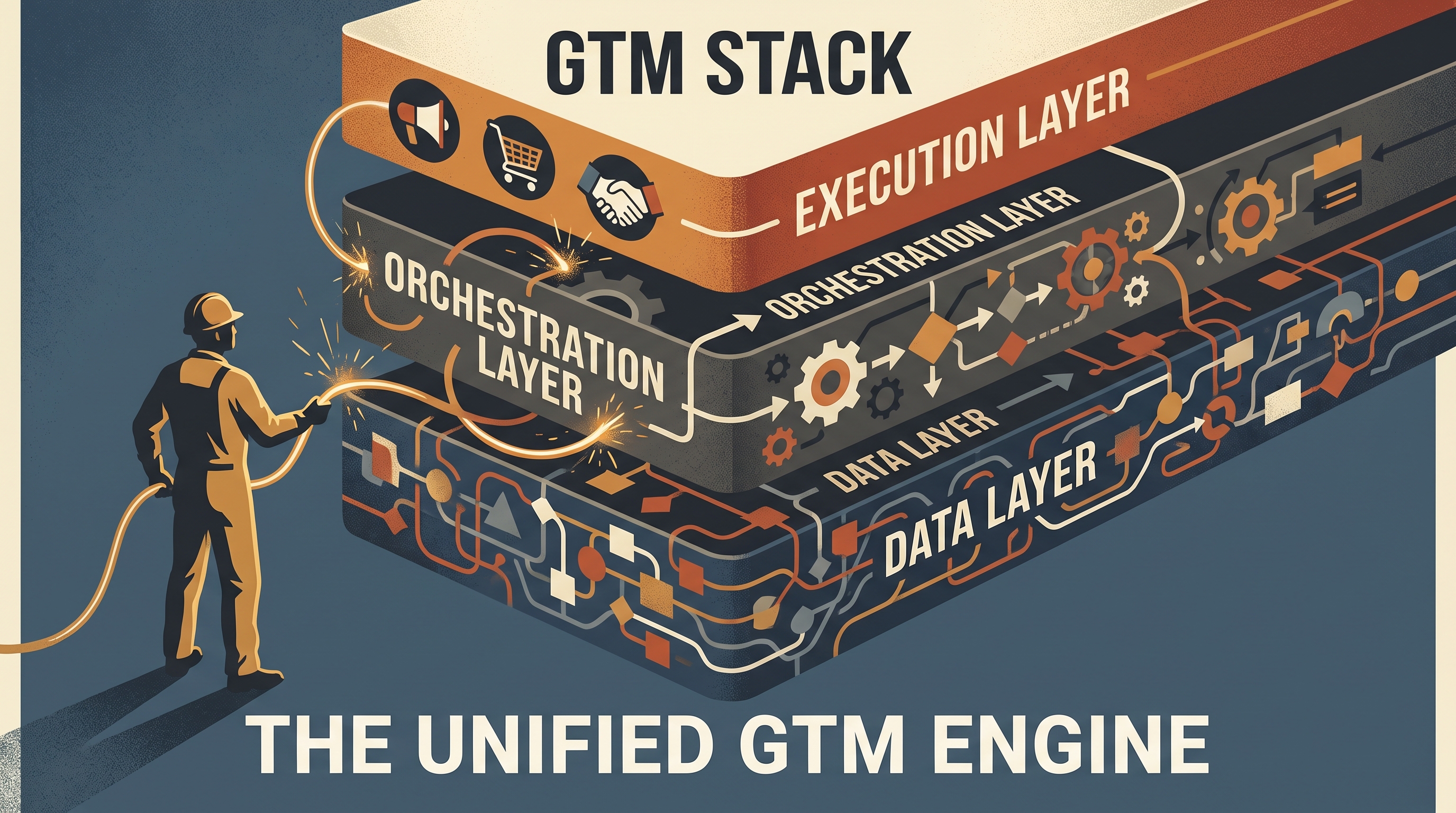
The title grew up inside the tooling wave it describes. Clay, the workflow platform that popularized the role, frames the winning system as four layers: data, orchestration, execution, and agents. Strip the branding and the shape is familiar to anyone who has built a data pipeline: collect, transform, act.
What changed is who does it. This work used to be split across an ops analyst, a data engineer, and a team of SDRs doing manual research. The GTM engineer thesis is that modern tools collapse those seats into one technical operator. Whether that thesis holds is the real fight, so let’s have it.
Is GTM engineering just RevOps with a new name?
Partly, yes. The workflow-ownership half of the job has existed for years under the RevOps title, and pretending otherwise is marketing. What is genuinely new: the pipeline from raw data to sent message is now written in code and prompts, and one person can operate what used to need a team.
The skepticism is loud where practitioners actually talk. In the r/sales thread that ranks second for this exact query, one commenter calls the role “revenue operations rebranded to sound more fancy”; another shrugs that it is “a SaaS derived title so it can mean anything to anyone at this point”. That thread outranks most vendor content, which says something about how satisfying the vendor answers are.
Our take, plainly: the difference that matters is build versus configure. A RevOps manager configures tools inside their admin panels. A GTM engineer writes the glue those panels never shipped: API calls, custom enrichment chains, agent prompts. ZoomInfo lands close to this, placing the role at the intersection of RevOps, marketing ops, data engineering, and prompt engineering. If nobody at your company writes that glue, you do not have a GTM engineer, whatever the org chart says.
What a GTM engineer actually does all day
The job-ad version lists strategy and vision. The real day is plumbing, and ZoomInfo’s responsibility list is honest about it, putting “build automated enrichment workflows” first. Everything downstream starves without that first pipe.
The recurring buckets:
- Enrichment workflows: turn a raw account list into complete, current records automatically.
- Signal operations: catch hiring spikes, funding events, and engagement, then route them to the right sequence.
- AI wiring: put models and agents inside the stack, with prompts treated as production code.
- Technical revenue plays: one-off builds like scraping a conference attendee list into a campaign.
- Data hygiene: dedupe, normalize, and keep the CRM from rotting.
The leverage claim is real but has a ceiling. One r/sales commenter describes the role as a hybrid that “uses AI and automation so that one person can do the job of 5 SDRs”. The same thread supplies the warning label: “Clay emails can be spotted from a mile away.” Automation multiplies whatever you feed it, quality and slop alike. Which layer decides the outcome? The one underneath everything else.
The stack is three layers, and the data layer decides the other two
The consensus architecture is three layers: data, orchestration, and execution. Data is enrichment, intent, and identity. Orchestration is workflow logic and scoring. Execution is the sequencers, ads, and agents that touch the buyer. Clay adds agents as a fourth layer, but the dependency order never changes: orchestration can only route what the data layer feeds it.
Full disclosure: we build data-layer tools (Atomus makes LinkedIn data APIs), so this is our seat at the table. Read what follows knowing that.
From that seat, the failure pattern is consistent. Our actors have run roughly 2 million profile enrichments in total, according to our own Apify telemetry, and the workflows that disappoint are rarely broken at the orchestration layer: they are fed stale titles, empty fields, and contacts who changed jobs two quarters ago. The “spotted from a mile away” email usually fails before anyone writes copy, when a template gets populated from a dead record.
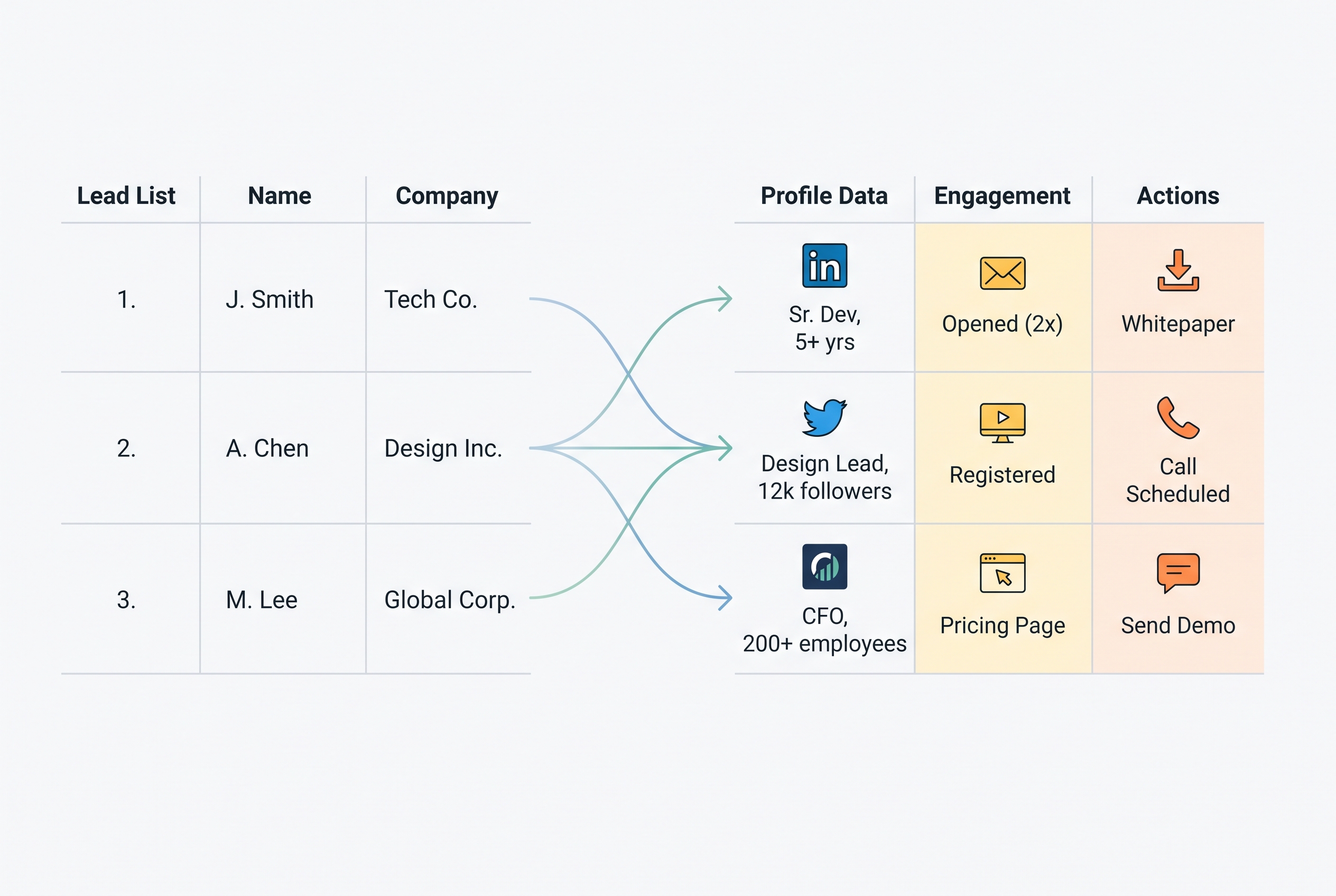
That is also why fresh engagement data beats static databases for outbound. A record that says someone reacted to a competitor’s post this week is a live signal; a record that says they held a title when a database last crawled them is an assumption. Garbage in, automation out. With the layers clear, the tool map gets much easier to read.
Which tools do GTM engineers actually use?
By layer, in 2026: Clay or n8n for orchestration, a static database like Apollo or ZoomInfo plus live scraper APIs for data, sequencers and agents for execution. Clay states its own position bluntly: “Now, Clay is the infrastructure GTM engineers build on”. Vendors write most of this category’s content, ours included, so weigh every recommendation against where its author sits.
| Layer | What it does | Typical tools |
|---|---|---|
| Data (static) | Firmographics, contact databases | Apollo, ZoomInfo, Lusha |
| Data (live) | Fresh signals scraped on demand | Atomus, other Apify actors |
| Orchestration | Workflow logic, scoring, routing | Clay, n8n, Zapier |
| Execution | Sequences, ads, AI agents | Smartlead, Instantly, custom agents |
On the live-data row: Atomus is ours. Our actors pull LinkedIn profiles, posts, reactions, and comments as clean JSON, with per-event pricing published on each listing ($6 per 1,000 profiles found, on the profile scraper). They use no LinkedIn account or cookies, so there is no account to burn, and each scraper ships a machine-readable schema plus an llms.txt so AI agents can run them directly through Apify’s MCP integration.
The practical pattern we see: a Clay or n8n table as the spine, a static database for the base record, a live scraper step for the signal, and an agent writing against both. Every piece is replaceable. The pattern is the point, and it is also the answer to the hiring question.
Most teams need the plumbing before the title
Here is the test. Count your active outbound segments and your weekly signal volume. One segment, one pipeline, a few hundred contacts a month: a workflow tool plus a data API covers it, and a full-time GTM engineer would spend four days out of five idle.
Concretely, the starter version is small: an n8n or Clay table as the spine, one enrichment step against a live data source, one sequencer at the end. That build is a weekend project for anyone who can read API docs, and it surfaces whether you have enough signal to justify a hire.
Hire when the plumbing outgrows part-time attention: multiple segments with different signals, agents running in production, revenue plays queued because nobody can build them. The r/sales skeptics are right that a title alone changes nothing. The pipeline is the job. Build it first, name it later.
Frequently asked questions
- What does GTM stand for?
- Go-to-market. In this context it covers the whole motion that takes a product to buyers: marketing, sales, and the systems underneath. It is not Google Tag Manager, although at least one confused r/sales commenter guessed exactly that, which tells you how young the title is.
- What is a GTM engineer's salary?
- There is no reliable published band yet. The title is young, definitions vary by company, and identical work ships under RevOps or growth engineering titles at different pay. Check live postings for your market and read the responsibilities, not the title, when comparing.
- Is GTM engineering a good career?
- The skills are a good career; the title may or may not survive. Enrichment pipelines, workflow orchestration, and prompt engineering transfer to RevOps, data, and growth roles even if the label consolidates. Learn the stack and the title question answers itself.