LinkedIn API Pricing in 2026: Why There Is No Price Page, and What Access Really Costs
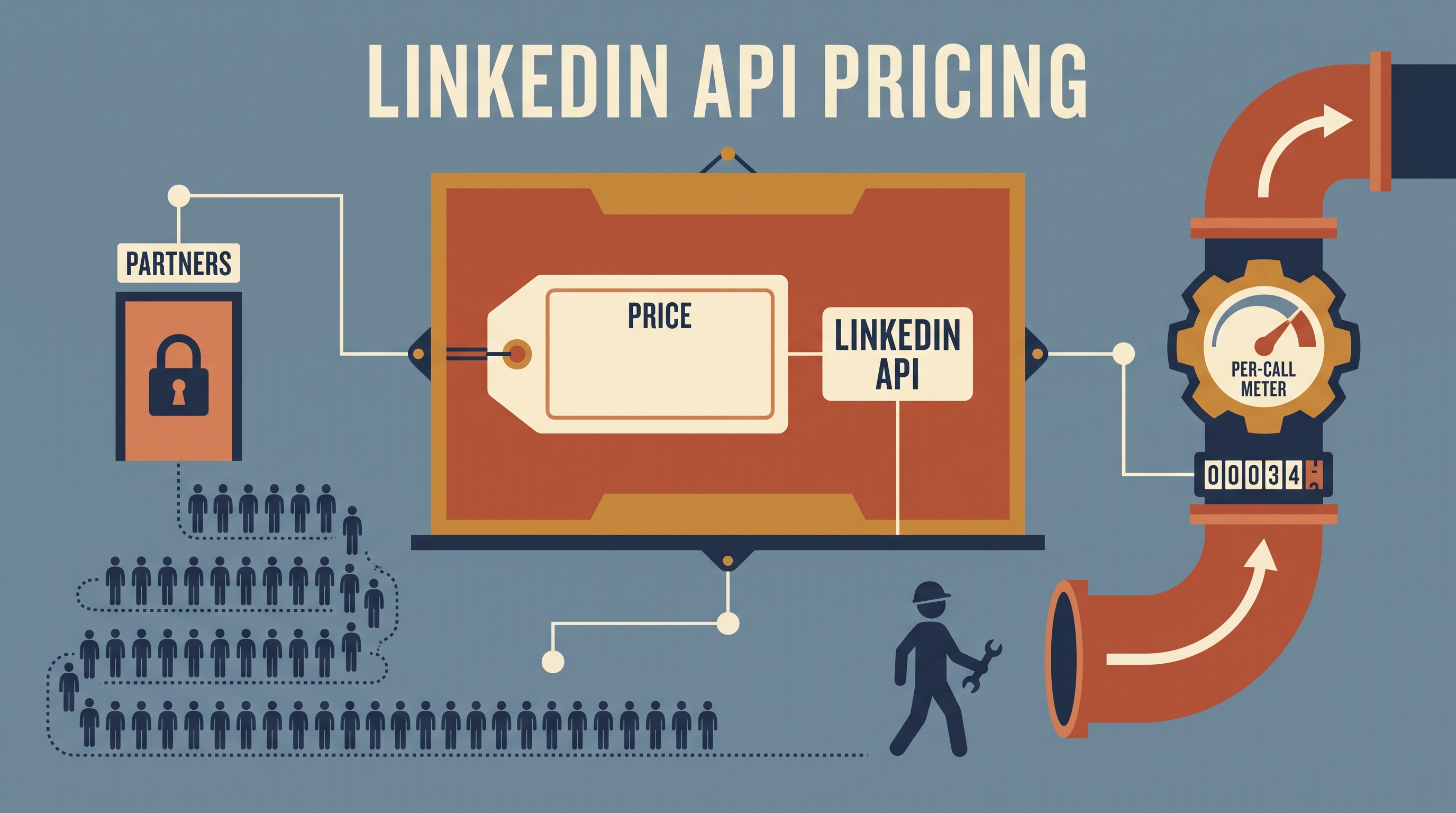
Go looking for LinkedIn’s API pricing page and you will not find one, and that absence is the actual answer to the query. There is no public price because the official API is not a product you buy; it is a partnership you apply for, and most applicants never get it. We should say up front that we sell LinkedIn scraper APIs, so we profit from that closed door, and you should read our take on it knowing that.
Key takeaways
- LinkedIn’s official developer offering has no self-serve pricing page; access runs through partner programs with an application and an approval queue.
- The most honest sentence in the ecosystem’s own guides: “Gaining access is not as straightforward as signing up. You generally need to apply, wait for approval, and fit within a partner or approved product track.”
- The closest thing to a published LinkedIn data price is Sales Navigator, a human seat, not an API.
- The practical market answer is per-result scraper APIs, which is the corner we operate in, so discount our enthusiasm appropriately.
Does LinkedIn have an API for free?
Yes, for a narrow set of jobs. Sign In with LinkedIn, sharing posts to a profile or page, and basic OAuth flows are free through the developer product catalog. What is not free, or even purchasable, is what most people typing this query want: programmatic access to profile, company, and jobs data.
Those live behind named programs, People Profiles, Company Profiles, Jobs, Marketing, and Learning, each with its own partner track. The free tier exists so apps can authenticate people, not so builders can read the graph. The data products are where the pricing question gets interesting, because there is no price to read.
There is no pricing page, and that is the pricing
The official route is an application, not a checkout. In the words of one widely cited access guide: “Apply through the relevant LinkedIn developer or partner program. Wait for approval from LinkedIn”, and “approval can take weeks or months. LinkedIn can limit access based on your category, business model, and intended use”.
Developer forums are blunter. The line that echoes across threads on this topic is verbatim: “You can’t do that with the linkedin APIs. Impossible to gain access, trust me.” That is survivor bias in reverse: the developers you hear from are the ones who applied and heard nothing. As the same guide puts it, “if your team needs data this quarter, a multi-month approval cycle is not just inconvenient. It can kill the project.”
So when a build depends on LinkedIn data, the pricing question quietly becomes a sourcing question. Before it does, it is worth naming the one LinkedIn data price that is actually public.
The only published LinkedIn data price is a seat, not an API
Sales Navigator runs $99.99 to $149.99 per month, per user. It is a human license: a browser, a search UI, and export limits, with no programmatic access attached. Teams end up treating it as an API substitute anyway, pointing browser extensions or virtual assistants at it, which violates the terms they clicked through and scales exactly as well as a browser tab does.
That is the whole official menu. A free auth tier, a partner gate most builders never pass, and a per-seat research tool. Everything else in this market is unofficial, which is the part every pricing guide dances around and the part worth being direct about.
Can I use LinkedIn API? The honest decision tree
If you are building marketing tooling for pages and ads, or learning integrations, apply to the matching partner program; those tracks approve real companies. If you need people or company data inside your product this quarter, the realistic answer is an unofficial API, meaning a scraper: infrastructure that reads public LinkedIn pages and returns them as structured JSON.
Be clear-eyed about what that means. Scraping public pages sits outside LinkedIn’s terms of service even where courts have treated public-data scraping as lawful, and vendors who pretend otherwise are selling you comfort, not fact. The engineering trade is different too: an official API would give you contractual stability; a scraper gives you immediate access, per-result pricing, and a vendor whose job is absorbing the cat-and-mouse. Which brings the pricing question back to numbers that actually exist.
What scraper API pricing looks like, from a vendor’s own books
Per result, published, no application. Our earned opinion after running this infrastructure: the real price of LinkedIn data is per record retrieved, and any pricing model that hides that unit is charging you for something else, a seat you will not fully use or a database that is already aging.
On our Apify actors, a call that finds nothing costs nothing, and rates are listed on the actor page the way a price should be, for example $4 per 1,000 post reactions scraped with no LinkedIn account in the loop.
The trade-offs, stated plainly:
- Skip Atomus if you need emails or phone numbers (we return neither), if you qualify for an official partner track and can wait for it, or if your compliance posture rules out ToS-adjacent sourcing entirely. For some teams it rightly does.
- Use a scraper API if you need profile, post, or engagement data now, priced per result, and you would rather read a rate card than file an application.
- Architecturally, this is a sourcing decision inside the data layer of a GTM stack, and it pairs with database enrichment the way we described in our look at lead enrichment: cache for coverage, live calls for freshness.
The summary we would want if we were buying: the official LinkedIn API has no price because it has no open product, the only published number is a per-seat research tool, and the working market rate for LinkedIn data is whatever per-result scrapers publish. Read every vendor’s rate card, including ours, with the same skepticism this page opened with.
Frequently asked questions
- Does LinkedIn have an API for free?
- Yes, for authentication and sharing: Sign In with LinkedIn and post-sharing flows are free through the developer catalog. Programmatic access to profile, company, and jobs data is not free or self-serve; it requires acceptance into a LinkedIn partner program.
- What is the 4-1-1 rule on LinkedIn?
- It is a content-sharing guideline, not an API rule: for every piece of content about yourself, share one relevant update and four pieces from others. It concerns posting etiquette and has nothing to do with API pricing or access.
- Can I use LinkedIn API?
- Only if your use case fits a partner track, such as marketing tools for pages and ads, and LinkedIn approves your application, which can take weeks or months. For people and company data inside a product, most teams end up on unofficial scraper APIs.
- How much is 1 month of LinkedIn Premium?
- Premium is a consumer subscription unrelated to API access, and its price varies by tier and region, with Career the cheapest and Sales Navigator the tier teams most often compare against data tooling. None of the Premium tiers include programmatic data access.